
Stems and Stalks in Sultana Raisins — and the Modern Sorting Solution
Manisa sultana raisins are one of the strong items in Turkey's exports — yet the stems-and-stalks clauses in buyer specifications put processors under pressure every season. In this guide we look at where the stems-and-stalks problem comes from, the limits of mechanical pre-cleaning, and the modern solution based on belt-type color sorting and shape analysis.
Manisa Sultana Raisins and Their Place in Exports
Turkey is one of the world's leading countries in sultana raisin production and exports, and the heart of that production lies in the vineyards in and around Manisa. Since most of the crop goes abroad, it is the export markets that set the quality bar. In the specifications of buyers such as European retail chains and the bakery and breakfast-cereal industries, the foreign material section almost always includes a separate clause on stems and stalks.
That clause usually defines the acceptable number or weight of stalks in a given sample quantity. When the limit is exceeded, the lot may be returned, reprocessing costs arise, or the price gets cut. In short, stems and stalks are a commercial criterion that decides whether a lot is accepted at all — before taste and appearance even enter the picture.
Why Does the Stems-and-Stalks Problem Never Go Away?
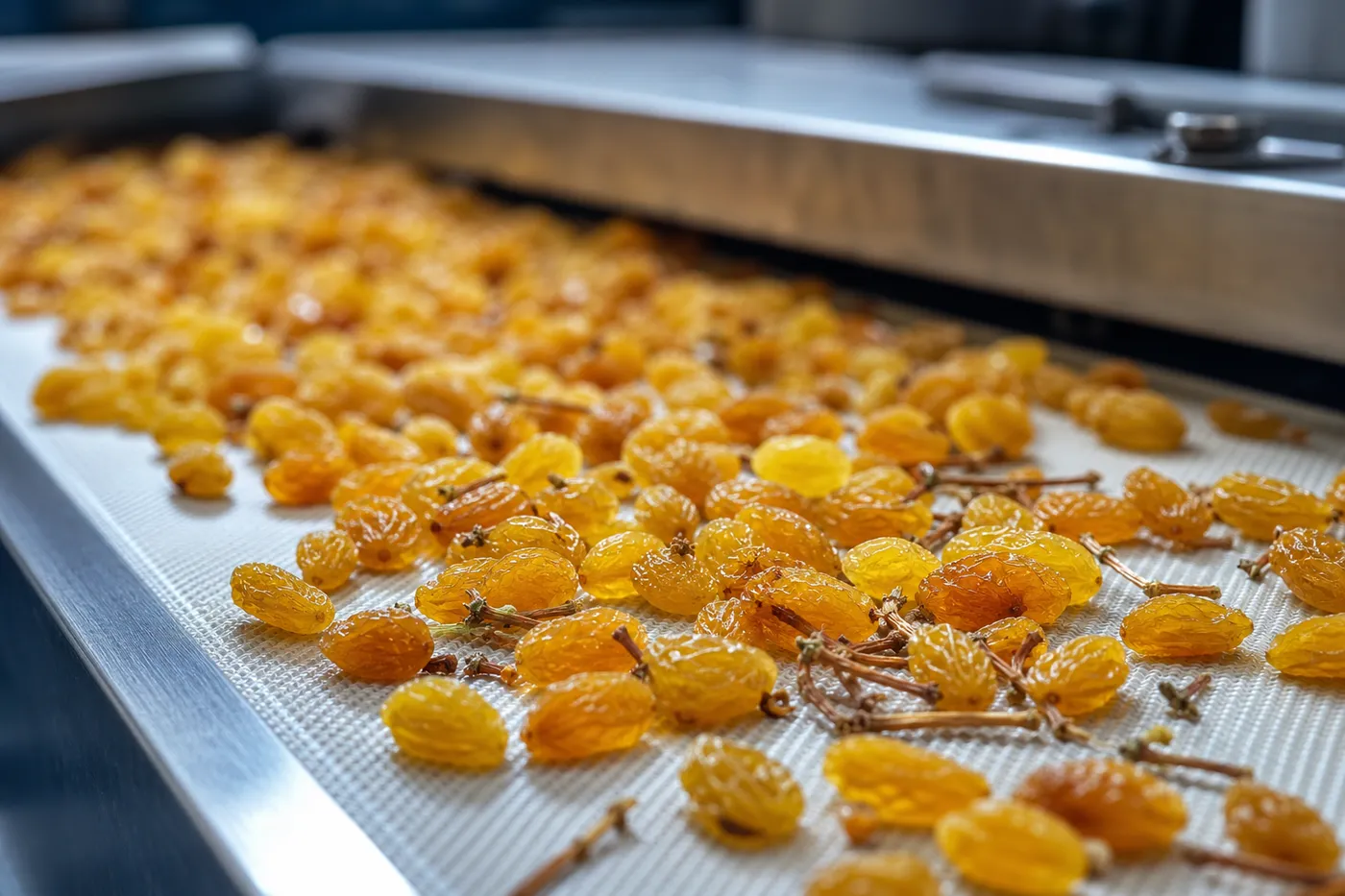
The root of the problem is the production method itself. Grapes are harvested in bunches and, after dipping, sun-dried on open drying grounds. During drying, collection, bagging, and transport, the bunch skeleton breaks up and stalk fragments of all sizes scatter through the product. To make matters worse, the color of a dried stalk moves closer to that of the raisin itself, so the problem becomes visually harder as well.
That is why hand sorting is still widespread — but its limits are clear. In peak season, experienced workers become hard to find, labor costs rise, and the human eye cannot hold the same focus through an entire shift. On a line processing tons of product per hour, trying to catch millimeter-scale stalk fragments at a picking belt is not a sustainable method on its own.
Where Do Screens and Aspirators Fall Short?
Mechanical pre-cleaning is the indispensable first step of every line. Screens work by size, removing large bunch skeletons and coarse debris. Aspirators use an air stream to carry away dust, leaves, and light fragments. The trouble starts with stalk fragments of similar size and weight to a raisin.
A short broken-off stalk passes through the screen aperture together with the product, and if its weight is also close to a raisin's, the air stream cannot separate it either. In other words, mechanical pre-cleaning handles the coarse contamination but cannot reach the fine fraction that actually strains the specification. At this point, a sorting principle other than size and weight is needed.
How Do Color Sorting and Shape Analysis Solve the Problem?
A modern belt-type color sorter spreads the product across a wide belt in a single layer, presenting every raisin to the cameras one by one. For sticky, moist products like raisins, the belt type is the preferred choice: the product grips the belt, does not bounce, and passes the cameras at a constant speed. That raises both image quality and sorting precision.
Two features give a stalk away. The first is geometry: a stalk is long and thin, while a raisin is oval and plump. AI-assisted shape analysis catches this difference even when the colors converge. The second is color: the matte, woody tone of a dried stalk stands apart from the raisin surface. When the two criteria are evaluated together, precision air ejectors blow the stalk fragment out of the product flow.
The critical figure to monitor here is carryover — the good product unintentionally sent to the reject stream along with the defects on the first pass. On a well-tuned machine this rate is kept low, and the reject is run through a second time to recover the good raisins in it. You can find application details for raisin lines on our dried fruit industry page.
A Complementary Solution for Stones and Minerals: X-Ray
A color sorter sees the surface; for dense foreign material such as stone, glass, and metal that is embedded inside the product or has taken on the same color as the raisin, a different principle is required. Because an X-ray food inspection machine looks at density differences, it catches these risks at the very last point of the line and forms a strong layer of assurance, especially for export lots.
Recommended Line Setup
- Pre-cleaning: Removing coarse debris, dust, and large bunch skeletons with screens and aspirators.
- Belt-type color sorting: Removing stems and stalks, color-defective raisins, and surface foreign material; recovering the reject with a re-sort pass.
- Final inspection: Pre-shipment verification with X-ray food inspection and a final inspection belt.
| Method | Sorting principle | Strength | Limit |
|---|---|---|---|
| Screen | Size | Large stalks, coarse debris | Stalk fragments the size of a raisin |
| Aspirator | Weight and airflow | Dust, leaves, light fragments | Stalks of similar weight to a raisin |
| Color sorter | Color and shape | Stems and stalks, color-defective raisins | Stone and glass embedded in the product |
| X-ray food inspection | Density | Stone, glass, metal | Color and shape defects |
Pre-season maintenance is the insurance policy for this setup. Camera calibration, ejector testing, and belt and lighting checks should be completed before the season starts, and stock of critical spare parts should be prepared in advance — because the most expensive downtime is an unplanned stop in the middle of the season. For maintenance and spare parts planning, see our service and spare parts page.
The SAGE Makine Approach
We are based in Manisa — right inside the region where sultana raisins are picked, processed, and loaded for shipment. With twenty-two years of industry experience, we start by listening to your product: we work with you to pin down the machine and line setup that fits your stem load and capacity target, and then present a transparent quotation. To talk through your product, all you need to do is get in touch.