
What Is Aflatoxin? Reducing the Risk in Dried Fruit and Pistachios
Aflatoxin is one of the most common reasons dried fruit and nut shipments are rejected at export. It is a risk that can never be brought all the way to zero, but it can be managed with the right practices. In this article we look at what aflatoxin is, why it matters so much, and the realistic role sorting plays in the process.
What Is Aflatoxin?
Aflatoxin is a toxin produced by certain molds—chiefly Aspergillus flavus and Aspergillus parasiticus—under favorable temperature and humidity conditions. It is a mold toxin that carries a health risk, which is why it is monitored so closely from a food safety standpoint. It can appear in particular in dried figs, pistachios, hazelnuts, almonds, peanuts and some dried fruits; because these products are among Turkey's most important exports, the issue speaks directly to a company's bottom line.
Aflatoxin is not always visible to the naked eye. Sometimes just a few defective kernels are enough to push the average of an entire batch above the limit set by regulation. It is precisely this statistical reality that keeps aflatoxin permanently on the producer's agenda.
Why Is It So Critical?
The reason aflatoxin gets so much attention is both its health dimension and its commercial consequences. The European Union and many importing countries have set legal upper limits for aflatoxin in dried fruit and nuts. The specific values of these limits vary by product and by regulation and are updated over time; for that reason you must always work from the current regulations and the requirements of the buyer's country.
In practice, the risk plays out like this:
- Border controls: At EU border checkpoints, increased sampling and analysis may be applied to products of certain origins. A batch held at the border means both time and storage cost.
- Batch-level rejections: If the analysis exceeds the limit, not just the problem kernels but the entire batch can be rejected. Returning, destroying or reworking the product creates serious cost.
- Reputation: Repeated rejections damage a supplier's credibility in the buyer's eyes and put future orders at risk.
In other words, aflatoxin is far more than the loss of a single batch—it is a matter of brand and commercial continuity.
The Source of the Risk: Where Does It Form?
The molds that produce aflatoxin are everywhere in nature; the problem is the conditions that allow the mold to produce the toxin. These conditions generally center on moisture and temperature:
- Field and harvest: Drought stress, insect damage and a mistimed harvest set the stage for mold growth.
- Drying: If the product is not dried quickly and evenly enough, moisture left on the surface creates an ideal environment for mold.
- Storage: In warehouses that are high in humidity or poorly ventilated, even dried product can reabsorb moisture and become a risk.
The most honest statement here is this: aflatoxin risk can never be brought all the way to zero, but with good agricultural and storage practices, sorting and analysis it can be managed. The goal is not to promise zero risk, but to build a system that keeps the risk under control.
The Role of Sorting: What a Color Sorter Can and Cannot Do
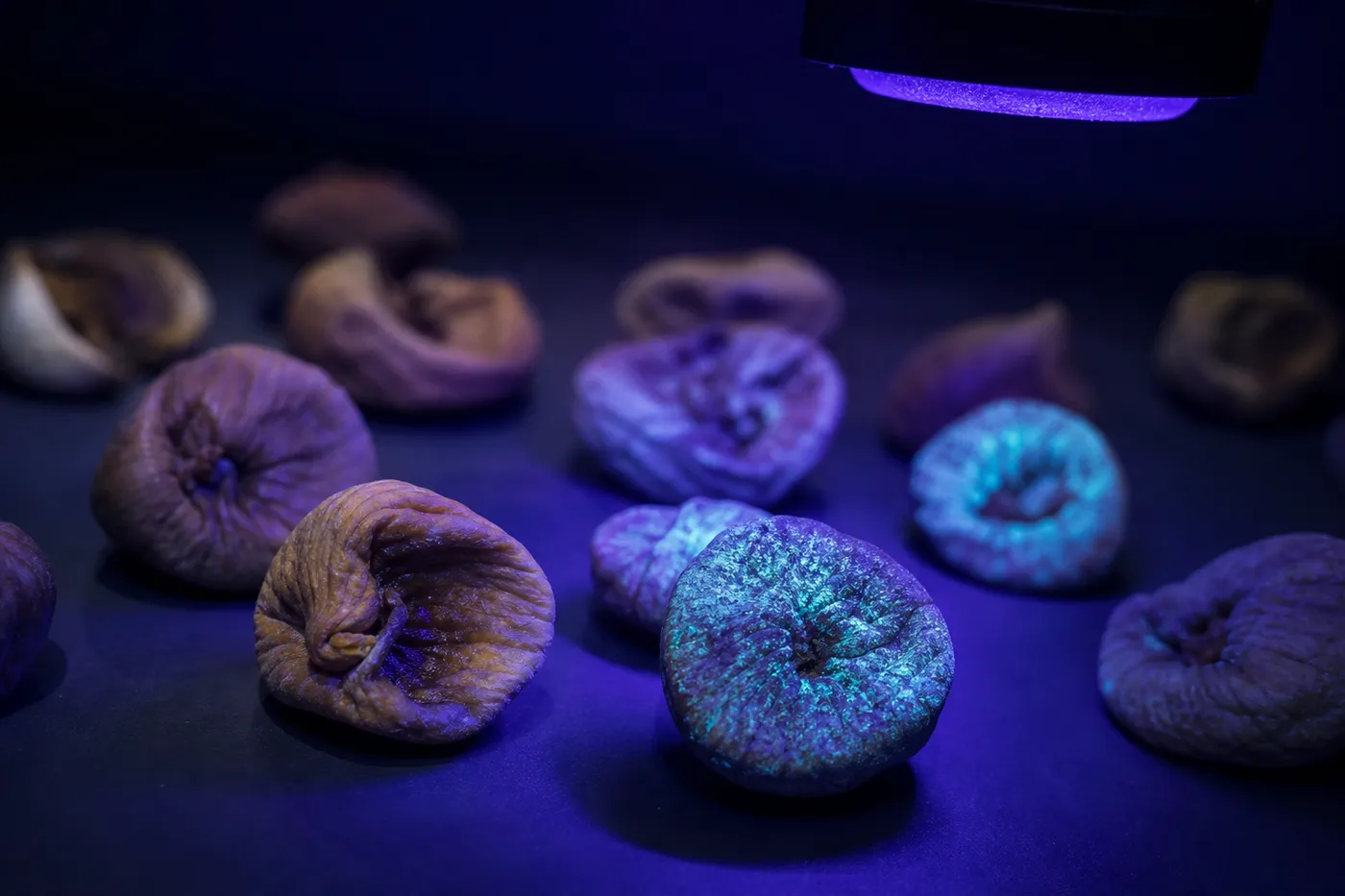
Kernels carrying aflatoxin often show visible defects: darkening in color, shriveling, rot and traces of mold. In dried figs, some kernels associated with mold and aflatoxin can show a characteristic fluorescence (glow) under ultraviolet (UV) light. These visible defects are the point at which optical sorting comes into play.
A color sorter scans the product kernel by kernel and diverts those that look suspicious in color and texture to the reject stream using high-speed air jets. In products such as figs, UV-camera systems can also catch fluorescing kernels that are hard to pick out by eye. By lowering the proportion of defective kernels, this sorting pulls down the batch average and so reduces the likelihood of exceeding the limit in analysis. This job is done by belt-type color sorters that scan the product kernel by kernel.
Complete honesty is essential here: a color sorter does not measure toxin. The machine is not a chemical analysis tool that reads the amount of aflatoxin in a kernel; it only reduces the risky kernels that carry a visible defect. There can always be a few isolated kernels that contain toxin but show no visible defect. That is why sorting does not replace laboratory analysis; it works together with it. The correct setup is this: the machine lowers the risky-kernel load, while accredited laboratory analysis confirms the true condition of the batch.
Practical Checklist
Managing aflatoxin risk rests not on a single machine but on an end-to-end approach. A summary checklist for producers:
- Drying hygiene: Dry the product quickly, evenly and under clean conditions; clean the drying area and equipment regularly.
- Moisture monitoring: Measure and record temperature and humidity in storage. Detect and separate batches that have absorbed moisture early.
- Sorting line: Sort out visibly defective kernels with a color sorter; for products that require UV, consider a UV-camera solution.
- Sample analysis: Take a representative sample using the correct method and have it analyzed at an accredited laboratory. The sampling method matters as much as the reliability of the result.
- Traceability: Keep every batch traceable with records of origin, drying, sorting and analysis. Reaching the source quickly when a problem arises limits the risk.
The SAGE Makine Approach
What we have seen over twenty-two years in the field is this: aflatoxin is not solved by a single machine but managed with the right setup. We position sorting as one part of that whole and give you realistic expectations. For sensitive products such as dried fruit and pistachios, the soundest path is to decide from your own product's defect profile rather than a catalog. Get in touch for a quotation; let us determine together which type of color sorter is right for your product.