
X-Ray or Metal Detector? Foreign Material Detection in Food
In food production, foreign material risk directly affects both customer trust and your access to export markets. Metal detectors and X-ray food inspection systems take two different approaches to that risk; which one is right for you depends on your product, your packaging, and your customers' requirements. In this article we compare the two technologies honestly.
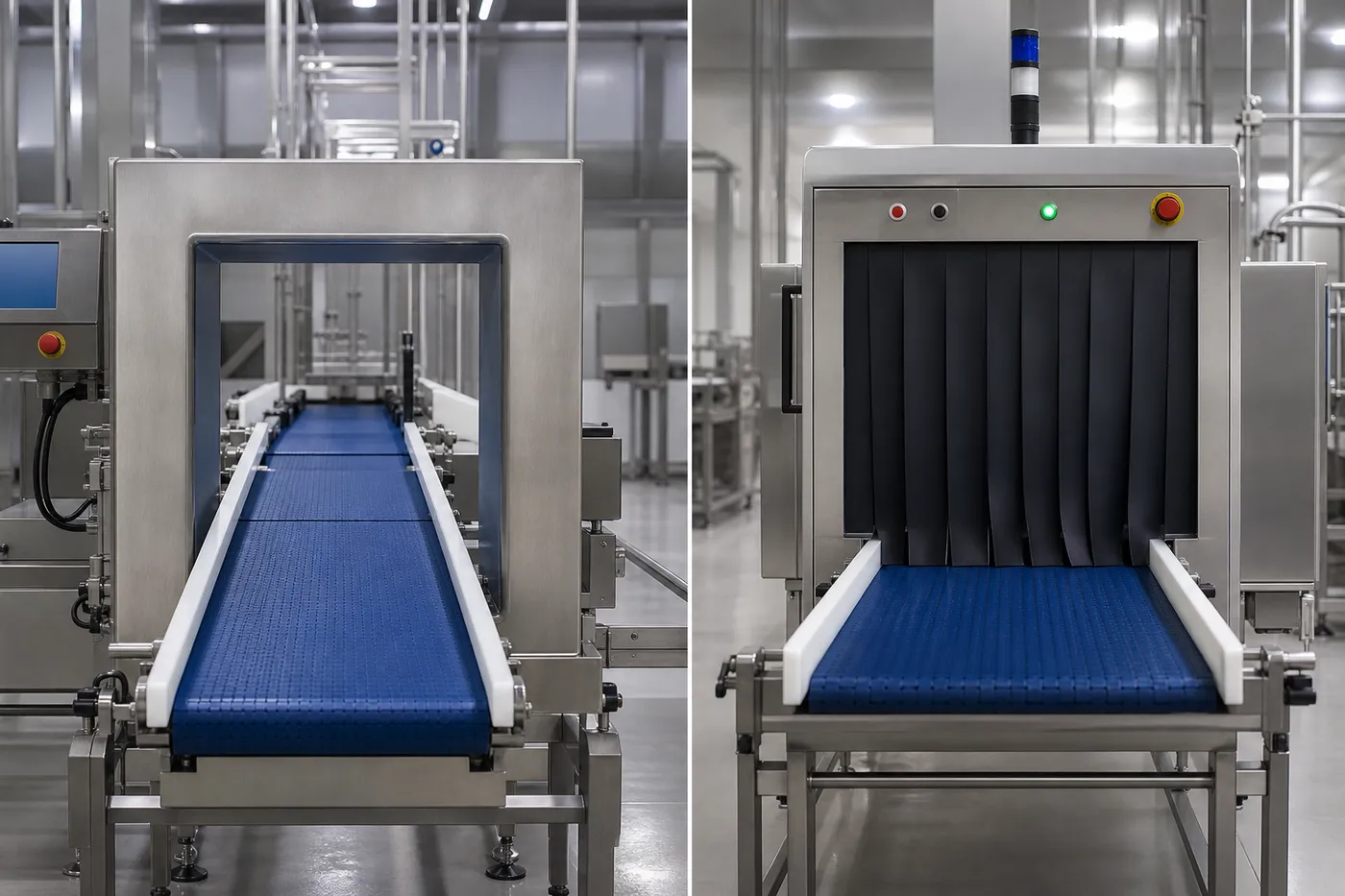
Two Technologies, Two Different Principles
A metal detector, as the name says, looks only for metal. Product passing through the unit travels through an electromagnetic field; when a ferrous, non-ferrous, or stainless-steel particle disturbs that field, the system generates a signal and diverts the suspect pack to the reject side with an air jet or pusher arm. It is a simple, dependable technology proven over decades — but it cannot see any non-metallic foreign material.
An X-ray food inspection system, by contrast, works on the principle of density imaging. As X-rays pass through the product, part of the beam is absorbed; any object noticeably denser than the product itself shows up as a dark spot in the image. Image-processing software evaluates those spots within milliseconds and directs the suspect pack to the reject stream. That makes it possible to detect not only metal but also glass, stone, dense bone, and dense plastics.
One important distinction: this comparison covers end-of-line inspection units that work on packaged product (X-ray also comes in dedicated models that sort bulk product in-line). They do not do the same job as a color sorter (also known as an optical sorting machine), which sorts bulk product kernel by kernel at the head of the line; the two are positioned to complement each other, not to replace each other.
An Honest Comparison Table
| Criterion | Metal Detector | X-Ray Food Inspection |
|---|---|---|
| Metal (ferrous, non-ferrous, stainless) | Detects | Detects |
| Glass | Cannot detect | Detects |
| Stone | Cannot detect | Detects |
| Bone | Cannot detect | Detects dense (calcified) bone |
| Dense plastic (PVC, PTFE, etc.) | Cannot detect | Detects |
| Operation with aluminum-foil packaging | Cannot operate, or only with severe limitations | Operates without issue |
| Fill and missing-product checks | Cannot | Yes (missing pieces, broken product, fill level) |
| Investment cost | Relatively low | Relatively high |
| Licensing requirement | None | Requires a license from the Turkish Nuclear Regulatory Authority (NDK) |
| Typical installation point | End of line, pack outfeed | End of line, foil and glass packaging, export lines |
To be honest, X-ray does not see everything either: low-density plastic film, hair, wood, and cardboard are difficult for X-ray as well. Very thin metal wires can also challenge both technologies, depending on their orientation. That is why no device replaces a well-designed hygiene and maintenance program — it only complements one.
When Is a Metal Detector Enough?
Not every operation needs an X-ray investment. If the following conditions all hold, a metal detector is a sensible, economical solution:
- If the risk is metal only: If your foreign material risk comes mainly from line equipment (knives, sieve wire, bolts, weld spatter), a metal detector covers it.
- If your packaging is foil-free: A metal detector works comfortably with clear film, PET, or cardboard packaging. If you use aluminum foil or metallized film, the picture changes; the special detectors developed for foil can only see ferrous metals.
- If the budget is tight: A metal detector is markedly cheaper both to buy and to run, requires no license, and operator training is short.
When Is X-Ray a Must?
In some scenarios, an X-ray food inspection machine is not a preference but a necessity:
- If there is a glass, stone, or bone risk: If you fill into glass jars, only X-ray will catch a glass fragment. In product coming in from the field (pulses, nuts, dried fruit), the risk of stones can never be brought to zero; however good the sorting at the head of the line, the final check is done with X-ray.
- If you use foil or metallized packaging: In these packs, where a metal detector is blind, X-ray detects even the metal inside the foil.
- If BRC, IFS, or a customer requirement applies: Major retail chains and European buyers are asking for X-ray inspection more and more often in supplier audits. Especially in dried fruit and nut exports, X-ray is a strong assurance item in the audit report.
One more thing to know on the X-ray side is licensing: operating an X-ray unit in Turkey requires a license from the Turkish Nuclear Regulatory Authority (NDK). Handled properly, the process is not an obstacle; it simply needs to be built into the planning ahead of installation.
When Do Both Together Make Sense?
In mid-size and large plants, the soundest setup is very often the two used together. Metal detectors at intermediate points in the process (before the mill, the chopper, or the filling machine) both protect the equipment and catch metal close to its source, so a problem batch is identified before the whole of it reaches the end of the line. X-ray then performs the final check at the end of the line, on packaged product, covering glass, stone, bone, and metal. In this setup the two technologies cover each other's gaps, and the risk of returns caused by foreign material is kept to a minimum.
The SAGE Makine Approach
Twenty-two years of field experience have shown us one thing clearly: the right answer is not the same in every plant. If your need is solved by a metal detector alone, we will say so plainly; if you face glass, stone, or foil-packaging risk, we will propose X-ray food inspection and, where needed, an integrated setup with a color sorter at the head of the line. To talk through the right setup for your line and get a quotation, just get in touch.